2026 State of the Workforce
Survey respondents demonstrated clear goals, challenges, and priorities for their health – as well as how they currently support it. These results lay a strong foundation for effective engagement.

Employees Care About Their Health
Across the board, survey respondents have multiple goals related to their health – reporting 5 health and lifestyle goals on average. This trend makes it clear that employees view health not as a single dimension of well-being, but as an interconnected set of priorities. They also expect employers to consider them in a similarly holistic way.
Generally, employee goals focus on lifestyle improvements, such as sleep, exercise, and nutrition. However, many respondents also cited goals focused more directly on the workplace:
- Nearly 1 in 2 employees at large and very large companies want to improve work-life balance
- 1 in 3 employees at all company types want to reduce stress and burnout
Top 5 Employee Health & Lifestyle Goals in 2026
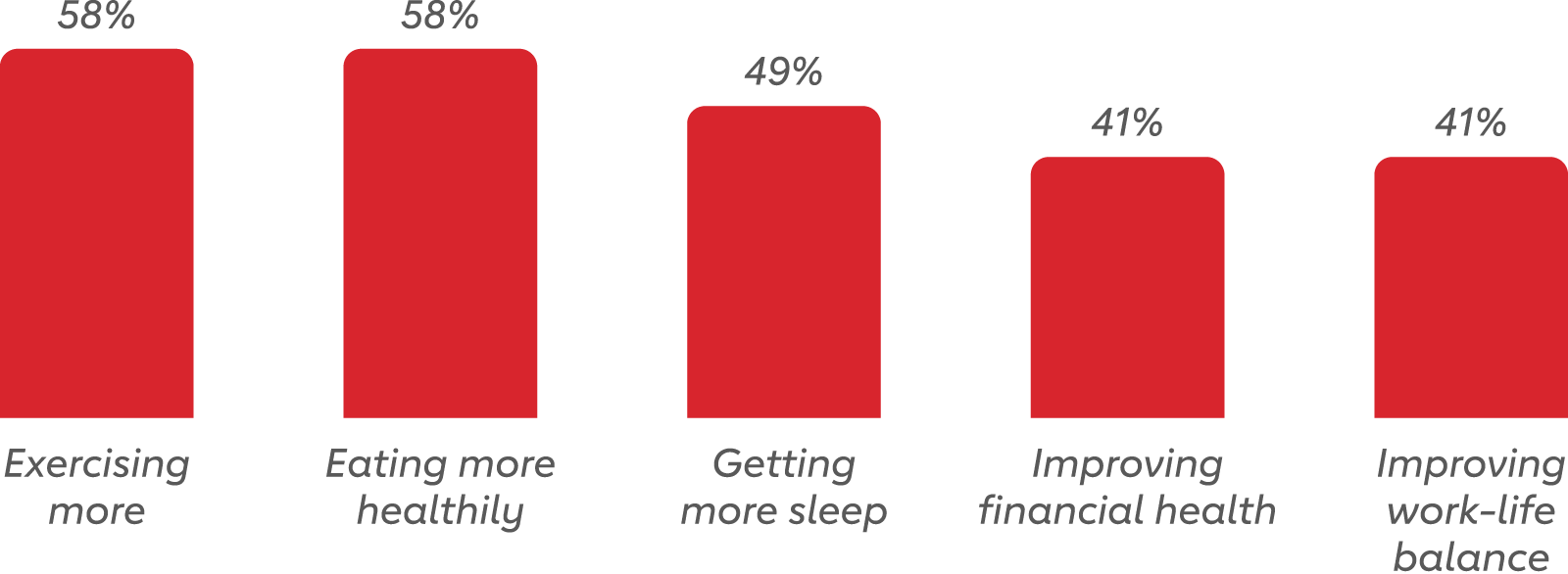
Of respondents are actively trying to improve their health and well-being.
Broad Employee Health Trends
Employees in 2026 are focused on their health and well-being.
Not only do they consider it a priority for themselves, but they also expect their employers to prioritize their health through policies and workplace values.
- 97% have health and lifestyle goals
- 90% would welcome more health-related support from employers
- 78% believe employers should play an active role in their health and well-being
Lack of Time, Motivation, and Support Can Hinder Employee Progress on Goals
While employees cite motivation for improving their health, several challenges and pain points impact their ability to achieve their goals.
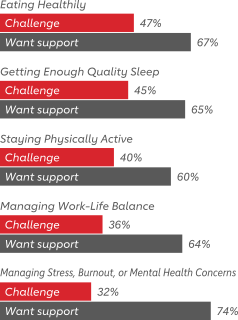
Across the board, those challenges align with employee goals – specifically around nutrition, sleep, exercise, stress management, and work-life balance.
Nearly 1 in 3 employees report difficulty finding the time to work on their health.
That challenge compounds when other stressors, including financial stress and caregiving obligations, enter the mix.
Of respondents say family and caregiving responsibilities make it hard to prioritize health.
I would appreciate more flexible scheduling options that allow me to balance personal responsibilities with work demands, reducing stress and giving me more time to focus on my physical and mental well‑being.
– Woman, 41 | Medium-size Company
Top 5 Employee Challenges in 2026 – and Where They Want Support*
Well-Being and Productivity
The strong employee focus on work-life balance and reducing stress and burnout demonstrates an opportunity to support employee well-being by optimizing how work is structured and experienced day to day.
Organizations with aligned workplace practices are better positioned to support well-being and productivity.
Employees Have Embraced Tools – and AI – To Manage Their Health and Track Goals
Of respondents use at least one tool in their daily lives to manage their health.
Employees across the board rely on multiple tools to support their health management and goals, using 3 tools or resources on average.
Additionally, over 1 in 4 respondents report using AI websites or apps as a tool for regular health management, and 73% are interested in AI solutions for health management provided by their employer.
Apps, memberships, and other tools that focus on lifestyle goals – specifically exercise and nutrition – rank among the most common resources for employees.
Top 5 Most Popular Tools for Employees
- Gym memberships or fitness classes
- Wearable health or activity trackers
- Mobile health or fitness apps
- Nutrition or healthy eating resources
- AI websites or apps (i.e., ChatGPT, Gemini, Copilot, etc.)
We leverage AI so much that it gives us an edge in understanding my health care benefits. I feel this helps us understand our health care benefits better because sometimes there’s just so much information to read at once, AI helps us to summarize key points and best way to go.
– Man, 50 | Medium-size Company
AI & Health Management
Employees are using AI for health guidance and to help translate their health benefits and insurance.
Some survey respondents also use AI as a triage tool to help them understand their symptoms and determine whether they should seek care.
However, the most common ways employees leverage AI focus on lifestyle and wellness support:
- 48% to manage stress or anxiety
- 47% to create workout routines
- 42% to track health goals
- 41% to develop meal plans and nutrition guidance
These numbers suggest that many employees are comfortable using AI to support daily lifestyle actions.